
Object Record
Images
Metadata
Catalog Number |
PH00038098 |
Object Name |
Specimen |
Title |
Lycopodium hypnoides |
Collector |
Frederick Pursh |
Date |
1806 |
Description |
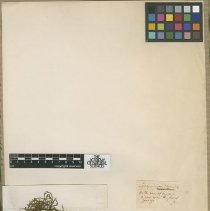
Lycopodium hypnoides "on the base of trees in a run near the Sweet Springs" |
Label |
Benjamin Smith Barton (1766-1815, APS 1789) was raised by a family of scientists with close connections to the American Philosophical Society, who encouraged his interest in botany from an early age. He studied medicine with a strong focus on medicinal plants and in 1789, Barton joined the College of Philadelphia, now the University of Pennsylvania, as the first professor of natural history in the United States. He also authored the first botanical textbook to be published in the United States in 1803. The earliest botanical specimens Barton and his collaborators gathered were for his two 1795 volumes of Herbarium Americanum, making Barton’s herbarium one of the oldest in the United States. In the following years, his herbarium at the APS grew to include over 2000 specimens, the nation’s largest herbarium of its time. This sheet contains a specimen of Lycopodium hypnoides which was collected, according to this sheet, “on the base of trees in a run near the Sweet Springs”. Frederick Pursh, a German born botanist and collector who worked for Barton, gathered this specimen during his southern expedition in 1806 in Sweet Springs, West Virginia. The name Lycopodium hypnoides does not correlate to a contemporary plant but does indicate that the specimen belonged to the Lycopodium genus of clubmosses. Lycopodium clavatum subsp. clavatum var. clavatum, the common clubmoss, is the contemporary Lycopodium species found in North America. |
Credit line |
American Philosophical Society |
Search Terms |
19th century botany herbarium nineteenth century plant specimen |
Collection |
The Benjamin Smith Barton Herbarium |