
Object Record
Images
Metadata
Catalog Number |
01.C.86 |
Object Name |
Globe |
Title |
Celestial Globe |
Artist |
Adams, George |
Date |
ca. 1766 |
Description |
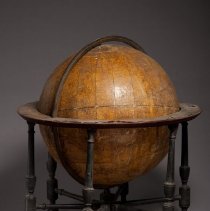
Celestial globe mounted on a four-legged wooden stand. Equator of stand notes months and corresponding astrological signs, as well as measurements affixed on paper. Brass meridian circle. Inscribed: "Britanniarium REGI Augustissimo/GEORGIO TERTIO. Astronomorum Patrono Munificentissimo, Celeberrimo Globum hunc Cælestem, Novam et Emendatiorem Cæti Imaginem, Syder apud Africæ Promontorium Aufrical nuperrime observata, Atq Stellas Catalogi Flamistediami Universas, vere exprimentem. Grati anime et pietatis Monumentum, D. D. Q. Omni cultu et officio devinctissimus G. Adams./Londinin apud G. Adams artificem Regium in vico Fleet Street." |
Label |
Celestial globes were used as decorations, for education, and also for navigation. The famed Adams family of globemakers produced this celestial globe in the 18th century; it was likely sold along with a matching terrestrial globe. George Adams Sr., his brother Dudley Adams, and his son George Adams Jr. became mathematical instrument makers to King George III. The cartouche in Latin on this globe bears a dedication to the king, and also states that the globe is “new and improved,” including recent observations made at the Cape of Good Hope by Nicolas Lacaille and stars found by John Flamsteed. Both men discovered new constellations and stars that greatly influenced celestial cartography and globe-making. The Adamses designed varying sizes and styles of globes for a variety of price ranges. The globe in this collection is a less expensive version, as shown by the plainer stand; some stands included a compass in the base. In 1766, George Adams Sr. noted that his globes "are of a construction new and particular; they are contrived to solve the various phoenomena of the earth and heavens." Each star on the globe has a letter in Greek next to it, and the constellations have names in English, along with descriptions in Greek and Latin and elaborate drawings showing the mythical event, creature, or person they were named for. |
Dimensions |
Dia-18 inches |
Credit line |
American Philosophical Society |
Search Terms |
18th century eighteenth century navigation astronomy |