Object Record
Images
Metadata
Catalog Number |
58.42 |
Object Name |
Polygraph |
Title |
Hawkins' Patent Polygraph |
Artist |
Hawkins, John I. |
Artist 2 |
Farthing, I.H. |
Place of Origin |
London, England |
Date |
1800-26 |
Description |
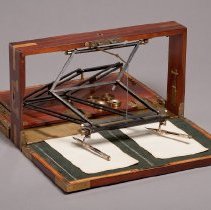
Elegantly made brass-bound wooden box with inlaid top. The top and bottom fold out to form a writing table. An integral frame supports two writing pens. A brass plate is inscribed, "Hawkins' Patent Polygraph, Manufactured and Sold by I.H. Farthing, No. 43, Cornhill, London. No. 282." (Robert P. Multhauf, "Catalogue of Instruments and Models," 1961). |
Label |
This "polygraph," meaning "writing of many," helped relieve the tedium of copying documents by hand. As the author of the original document moved one of the polygraph pens, the other moved simultaneously, producing an exact copy. John Isaac Hawkins patented the device in 1803, and Thomas Jefferson and Charles Willson Peale promoted its use. Jefferson, who wrote thousands of personal and professional letters, was a particularly enthusiastic endorser of the polygraph. This device, presented to the APS in 1850 by one of Jefferson's law students (and husband of his granddaughter), was reportedly owned and used by the president. |
Material |
Wood, metal, and brass |
Dimensions |
H-7.875 W-14.875 L-19.5 inches |
Dimension Details |
Box: 6 x 17 x 10.5 |
Credit line |
American Philosophical Society. Gift of Nicholas P. Trist, 1850. |
Search Terms |
19th century nineteenth century invention Founding Father writing instrument Jefferson |