Object Record
Images
Metadata
Catalog Number |
1955 1355misc |
Object Name |
Plate |
Title |
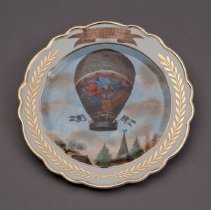
Balloon Plate |
Artist |
Siquier, J. |
Date |
1835 |
Description |
Light blue plate with wavy edged, gold trimmed rim, with decorative gold stalks of wheat on the lip of the plate. Central image on plate well is a hot-air balloon floating through a peach and blue sky above several pine trees. The balloon is decorated with a brick pattern (representing pieces of paper-backed cloth fastened together to form the balloon's skin), an arm holding a wreath, and a sheaf of wheat. On banner at top: "La Montgolfière de Sarcosta [?] à Versailles en présence de la famille Royale le 23 Juin 1784." Signed "J. Siquier 1835" at bottom. On reverse, crown symbol and X mark. |
Label |
This plate depicts an early experiment with hot-air ballooning, the first flight to exceed 31 miles (50 kilometers). On 23 June 1784, pioneering French aeronaut Jean-François Pilâtre de Rozier and chemist J. L. Proust ascended in a ballon called "La Marie-Antoinette" (named for the Queen), witnessed by King Louis XVI and King Gustav III of Sweden. The French court watched several balloon launches during this period, including the 1783 flight that carried the first passengers – a sheep, a rooster, and a duck. Benjamin Franklin, serving as American ambassador to France, observed at least one of the early balloon flights from the terrace of his home outside Paris. Pilâtre de Rozier was the first to die during a balloon flight; he perished in 1785 when his combined hot-air and hydrogen gas balloon exploded. The daring ascensions of the 1780s gripped the Parisian public, and “balloon mania” soon spread throughout Europe and America, with ballons portrayed widely in prints and the decorative arts. This plate, most likely part of a larger set (see also 1955 1356misc), is a typical example of popular balloon imagery. |
Material |
Porcelain |
Dimensions |
D-1 Dia-9.625 inches |
Credit line |
American Philosophical Society |
Search Terms |
18th century eighteenth century 19th century nineteenth century science France French tableware commemorative |