
Object Record
Images

Metadata
Catalog Number |
2009.81 |
Object Name |
Sundial |
Title |
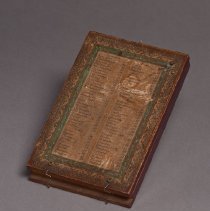
Diptych Sundial |
Artist |
Unknown |
Place of Origin |
Germany |
Date |
early 19th c. |
Description |
Rectangular wood dial covered with paper consisting of two leaves that fold flat. The dial is surrounded by a decorative border with a floral pattern. String gnomon (no longer extant) would attach between the inner surfaces of the two leaves. Exterior top: list of cities in the Americas, Italy, France, Spain, and Germany along with sundial's numerical position. Interior: sundial base and embedded compass (no longer functioning). |
Label |
With their printed paper faces, diptych sundials like this one were mass-produced throughout Europe at relatively low cost. Most diptych sundials were made in Germany, which became an important center for sundial craftsmen. These craftsmen made pocket sundials for multiple countries and audiences, as the list of cities in English on this instrument demonstrates. All sundials operate on the same principle: a pointer (also called a style or gnomon), casts a shadow on a surface, and that shadow will note the time of day. The diptych dial was one of the most common forms of portable sundial. A user told the time by aligning the dial north to south and reading the shadow cast by an adjustable string (now missing) that connected the instrument's top and bottom halves. Diptych dials were made out of ivory, wood, or occasionally metal, hinged together. The dials were normally designed to be used in more than one latitude. There was a series of holes in the upper leaf, through which the string could be threaded to adjust the angle to the appropriate latitude. In the 17th and 18th centuries, sundials became more popular, since they were necessary instruments to help set and regulate time on clocks. Their use decreased in the 19th century when electric telegraphs began communicating times across continents in a matter of minutes. |
Material |
Wood, glass, metal, and paper |
Dimensions |
W-3.25 L-5.5 D-0.75 inches |
Dimension Details |
Dimensions when closed |
Credit line |
American Philosophical Society |
Search Terms |
19th century nineteenth century astronomy timepiece scientific instrument navigation |