Object Record
Images
Metadata
Catalog Number |
PH-LC 90 |
Object Name |
Specimen |
Title |
Frangula purshiana |
Other Name |
Cascara |
Collector |
Meriwether Lewis & William Clark |
Date |
1806 |
Description |
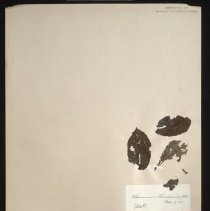
Frangula purshiana (DC.) J. G. Cooper, Pacif. Railr. Rep., Stevens Exped. 12: 57. 1860, a new name for Rhamnus alnifolius Pursh, Fl. Amer. Sept.: 166. Dec (sero) 1813 (non L'Her., 1788) = R. purshiana DC., Prodr. 2: 25. 1825. - Lectotype: PH-LC 91, left-hand fragment (Moulton 69b), designated here! Duplicate of the lectotype: PH-LC 90 (Moulton 69a). {N.B.: In Reveal et al.'s original text, the equals-sign preceding R. purshiana is typeset as three horizontal parallel lines, indicating a nomenclatural synonym, a symbol unavailable for this html document. -Spamer & McCourt, here} The separation of Frangula from Rhamnus is tentative, but as Moulton (in press) has adopted the above name, we retain it here. The type material was collected near Kamiah in Idaho Co., Idaho, on 29 May 1806 (Moulton, 1991: 302-308). Lewis makes no mention of the species. The following is material added to this electronic publication (E. E. Spamer and R. M. McCourt, PH). On PH-LC 91, Reveal et al. (1999) designate the "left-hand fragment", a Lewis collection, as the lectotype. The larger right-hand specimen is a Menzies collection probably from southwestern Canada or northwestern United States, according to Lambert's annotation (see below). We note that the two small, single leaves on either side of the Menzies specimen more resemble now the (dried) coloration of the Lewis specimen and question their association with the Menzies specimen. If they are Lewis-collected specimens, they are additional duplicates of the lectotype. (The Lewis & Clark Herbarium Digital Imagery Study Set, ANSP, 2002) On deposit at the Academy of Natural Sciences, Philadelphia |
Label |
Starting in 1803, Merriwether Lewis (APS 1803) and William Clark embarked on a 3 year expedition along the Missouri and Columbia rivers to the Pacific Coast. They collected hundreds of plant specimens to carry back to the East Coast. They pressed these plants, attached them to sheets of paper and wrapped them in oilskin to survive the long journey intact. These three heavily fragmented leaves belong to the plant Frangula purshiana, known commonly as the cascara plant, which can be found native across the Pacific Northwest, Pacific Coast, and northern Rocky Mountains regions of the United States. This particular specimen was collected by Lewis on May 29th 1806, during the expedition’s return journey through present day Kahiah in northwestern Idaho. While there are no documented uses of cascara in the Nez Perce region where this specimen was collected, other communities in the Pacific Northwest and Mountain regions used an infusion of the bark to treat a variety of primarily gastrointestinal issues. |
Credit line |
American Philosophical Society. Gift of Thomas Jefferson, 1805 - 1806. |
Search Terms |
19th century botany Clark herbarium Lewis nineteenth century plant specimen |
Collection |
The Lewis & Clark Herbarium |