
Object Record
Images
Metadata
Catalog Number |
2009.82 |
Object Name |
Sundial |
Title |
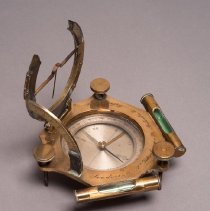
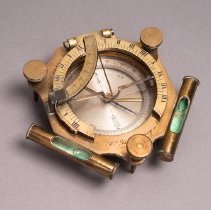
Universal Equinoctial Sundial |
Place of Origin |
France |
Date |
ca. 1800 |
Description |
Brass sundial with three adjustable legs and two levels attached to the side. Engraved along perimeter of top of compass: "Paris 49 Londres 51 St Petersbourg 59 Madrid 41 Milan 45", along with sundial's numerical position. Engraved on underside of compass: "Lisbonne 42 Constantinople 41 Berlin 52 Vienne 48 Hambourg 53." |
Label |
In the 17th and 18th centuries, before mechanical timekeepers were fully reliable, sundials like this one could have been used to set a grandfather clock in the home or to make a surveying calculation in the field. The use of sundials decreased by the mid-19th century, when electrical telegraphs began communicating times across continents in a matter of minutes. This instrument also included the names and latitudes of far-away cities to appeal to the user's fancy, even though he or she might never travel so far. All sundials operate on a similar principle: a pointer (also called style or gnomon), casts a shadow on a surface, and that shadow notes the time of day. Equinoctial sundials, such as the one seen here, had their pointers aimed at the North Star. On an equinoctial dial, all hour angles are at 15 degrees, and the dial contains a hinged ring that is positioned for the correct latitude. |
Material |
Brass and glass |
Dimensions |
H-1.5 W-4 L-4 inches |
Credit line |
American Philosophical Society |
Search Terms |
19th century nineteenth century timepiece astronomy surveying navigation scientific instrument |