
Object Record
Images
Metadata
Catalog Number |
58.34 |
Object Name |
Instrument, Magnetic |
Title |
Magnetic Instrument, for measuring the horizontal intensity of the earth's magnetism |
Artist |
Unknown |
Date |
ca. 1850 |
Description |
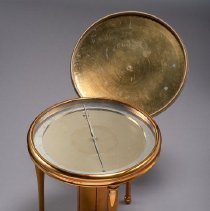
Brass instrument, with horizontal dial with a 5 3/8" needle and scale from 0 to 110. The needle is mounted on a vertical spindle about 5" long. The spindle is mounted on bearings at top and bottom, the latter being a needle in the center of a mica disc. A fine spiral spring extends over 4" of the spindle, and is attached to it at the bottom and to the frame at the top. The spindle and spring are covered by a brass housing which can be pulled off. Instrument has ill-fitting top which may not be original. Top is inscribed with "S. Homer May 27 1863" and "Samuel Homer Aug 27 1863." |
Label |
This magnetic instrument was used in the 19th century to measure the horizontal intensity of the earth's magnetism. Unlike the variation transit (see 2009.17), which measured the deviation or variation between magnetic and true north, this instrument measured the changing intensity of the earth's magnetic field. APS tradition links this instrument with Alexander Dallas Bache, great-grandson of Benjamin Franklin. In the 1830s and 1840s, Bache participated in the increasingly popular research into the magnetic measurement of the earth. Bache may have used this instrument at his Girard College observatory, although there is no mention of an instrument that fits this description in his works related to magnetic research at Girard. There is also no concrete documentation that this item was indeed part of the instrument collection of Alexander Dallas Bache. The inscription on the lid, which mentions the name “Samuel Homer,” also remains a mystery. |
Material |
Brass and glass |
Dimensions |
H-6.75 Dia-6.625 inches |
Dimension Details |
Height incl. top |
Credit line |
American Philosophical Society |
Search Terms |
19th century nineteenth century measurement science surveying scientific instrument |