
Object Record
Images
Metadata
Catalog Number |
58.23 |
Object Name |
Clock |
Title |
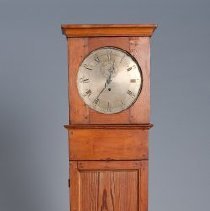
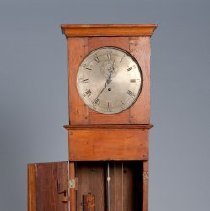
Astronomical Clock |
Artist |
Rittenhouse, David |
Place of Origin |
Pennsylvania, United States |
Date |
1769 |
Description |
Pine case without embellishment. The dial is 10 5/8" diameter, probably of cold silvered brass. Unmarked. Heavy brass plates with a pillar at each of the four corners contain the deadbeat escapement and going train of two many-toothed wheels. The motion work is between the dial and front plate. A small gear on the #2 gear arbor drives a large gear carrying the minute hand. The hour hand is driven by the latter gear through a compound idler gear and pinion. The second hand is mounted on the escape wheel arbor. The pendulum vibrates seconds and is mercury compensated. It is in two pieces connected by a yoke, and suspended by two springs. A thermometer is mounted on the back of the case. (Robert P. Multhauf, "Catalogue of Instruments and Models," 1961). |
Label |
David Rittenhouse built this tall case clock for his astronomical observations and surveying work. The plain pine case houses a highly accurate and efficient time-keeping mechanism. The clock was one of the most important tools Rittenhouse used at his observatory in Norriton, Pennsylvania during the 1769 transit of Venus across the sun. During observations in Wilmington, Delaware, in 1784, as part of the survey to extend the Mason-Dixon Line, the pendulum swung too freely. Rittenhouse cut holes in the case to keep the bob from hitting the sides and causing irregularities. |
Material |
Pine |
Dimensions |
H-83 W-14.75 D-9 inches |
Credit line |
American Philosophical Society. Gift of the estate of David Rittenhouse, 1810. |
Search Terms |
18th century eighteenth century Philadelphia timepiece surveying astronomy measurement scientific instrument |