
Object Record
Images
Metadata
Catalog Number |
1976.4 |
Object Name |
Andiron |
Title |
Set of Andirons |
Artist |
King, Daniel |
Date |
ca. 1770 |
Description |
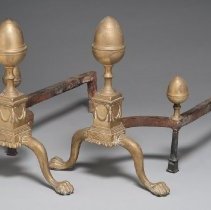
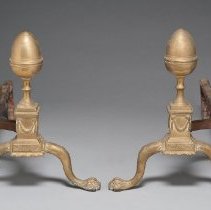
Etched acorn top set upon slender spool-turned section over festoon-molded square plinth. Plinth steps down into gadrooned apron-molding on cabriole leg with lozenge on knee and ends in delicately worked hairy paw-foot. Worked to top with bold dentate leaf border joining plinth base. Wrought-iron supports are surmounted with smaller conforming brass acorns and raised on tapered round legs with square feet. (Murphy D. Smith, "Due Reverence," 1992). |
Label |
These andirons were presented to the APS by a descendant of Caspar Wistar. Wistar was a physician and member of the APS, serving as President in 1815. His grandfather, also named Caspar, came to the Philadelphia area from Germany in 1717 and founded a brass button factory, as well as the Wistarburgh Glassworks in Salem, NJ. Once attributed to the Wistar brass foundry, these andirons have now been identified as likely by Daniel King, a Philadelphia brass manufacturer, because of their hairy-pawed feet. Andirons, also called iron dogs or firedogs, supported firewood, raising the wood off the ground to improve combustion. With the rise of coal-powered heat in England, and the decline of British andiron production, Americans had to manufacture their own. Andirons such as these, of a more elaborate design and with high-quality workmanship, were made for the wealthiest of clients and could be as expensive as a high-quality desk or bookcase. Daniel King was the most prominent brass craftsman working in the middle of the 18th century. He made a number of other objects in brass, including fireplace fenders, candlesticks, door knockers, and bells. |
Material |
Brass and iron |
Dimensions |
H-16.5 W-25 D-14 inches |
Credit line |
American Philosophical Society. Gift at the bequest of Mrs. Henry Goddard Leach, 1975-76. |
Search Terms |
18th century eighteenth century furniture |